Six Sigma Basic Tools And Techniques Free
Basic Lean Tools and Techniques. (Pages 5 to 6). • Basic 6 Sigma Tools and Techniques. (Pages 7 to 12). • Lean Six Sigma (LSS). • Lean Six Sigma DMAIC Tool. (Pages 14 to 22). • Lean Six Sigma SIPOC Tool. If you want a process that is fast, defect free, and without waste, then you need LSS. • LSS has the.

To apply Six Sigma to your business and produce the best results, you need to understand what Six Sigma is, the principles of Six Sigma, and the DMAIC problem-solving method. The correct tools and use of the Six Sigma scale and methods will keep your data dependable and reusable.
What Is Six Sigma?
Generally, Six Sigma is a problem-solving methodology that helps enhance business and organizational operations. It can also be defined in a number of other ways:
Six Sigma Templates
A quality level of 3.4 defects per million opportunities
A rate of improvement of 70 percent or better
A data-driven, problem-solving methodology of Define-Measure-Analyze-Improve-Control
An initiative taken on by organizations to create bottom-line breakthrough change
Keep in mind this was a NEW STORE. Gpsmapedit 1 0 66 7 crackles.
Lean Six Sigma Templates Free
Six Sigma Principles
Six Sigma is based on a handful of basic principles, and these principles create the entire Six Sigma arrangement. Here are Six Sigma’s fundamental principles:
Y=f(X) + ε: All outcomes and results (theY) are determined by inputs (theXs) with some degree of uncertainty (å).
To change or improve results (the Y), you have to focus on the inputs (theXs), modify them, and control them.
Variation is everywhere, and it degrades consistent, good performance. Your job is to find it and minimize it!
Valid measurements and data are required foundations for consistent, breakthrough improvement.
Only a critical few inputs have significant effect on the output. Concentrate on the critical few.
Every decision and conclusion has risk (ε), which must be weighed against the context of the decision.
The Six Sigma Scale
The Six Sigma scale shows how well a vital feature performs compared to its requirements. The higher the sigma score, the more efficient the feature is. This table shows the universal Six Sigma scale:
| Sigma Level (Z) | Defects per Million Opportunities (DPMO) | Percent Defects (%) | Percent Success (Yield %) | Capability (CP) |
|---|---|---|---|---|
| 1 | 691,462 | 69 | 31 | 0.33 |
| 2 | 308,538 | 31 | 69 | 0.67 |
| 3 | 66,807 | 6.7 | 93.3 | 1.00 |
| 4 | 6,210 | 0.62 | 99.38 | 1.33 |
| 5 | 233 | 0.023 | 99.977 | 1.67 |
| 6 | 3.4 | 0.00034 | 99.99966 | 2.00 |
The DMAIC Method of Six Sigma
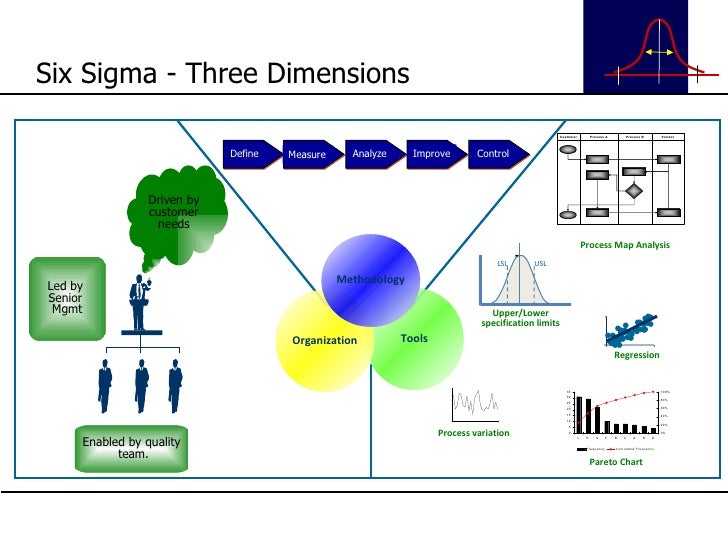
The DMAIC (Define-Measure-Analyze-Improve-Control) project method is a formalized problem-solving process of Six Sigma. It’s made-up of five steps to apply to any procedure of a business to improve effectiveness.
Define: Set the context and objectives for your improvement project.
Measure: Determine the baseline performance and capability of the process or system you’re improving.
Analyze: Use data and tools to understand the cause-and-effect relationships in your process or system.
Improve: Develop the modifications that lead to a validated improvement in your process or system.
Control: Establish plans and procedures to ensure that your improvements are sustained.
The Tools-Methods Landscape of Six Sigma
Having the right tools and knowing how to apply them to your Six Sigma projects will help you produce accurate, acceptable, and reusable outcomes. Here’s an overview of the Six Sigma landscape:
- Subject Catalog
- Humanities & Social Sciences
- Communication, Film & Theatre Catalog
- English
- Interdisciplinary Studies
- World Languages
- Math & Science
- Biology & Microbiology
- Mathematics
- Statistics
- Professional & Career
- Business
- Culinary, Hospitality, Travel & Tourism
- Education
- EMS & Fire Science (BRADY)
- Engineering
- Fashion & Interior Design
- Health Professions
- Information Technology
- Nursing
- Trades & Technology
- Sign in to download instructor resources
- Humanities & Social Sciences
- Products & Services for Teaching
- Digital Learning Environments
- Nursing Concepts Curriculum
- Course Content
- Textbooks & eTextbooks
- Pearson eText
- Textbooks & eTextbooks
- Distance Learning Solutions
- CourseConnect
- Support
- NCCERconnect
- Support
- Propero
- For Students
- For Educators & Institutions
- Success Stories
- Support
- CourseConnect
- Learning & Engagement Tools
- Duolingo
- Learning Catalytics
- User Stories
- Training & Support
- For Educators
- For Students
- Pearson Writer
- Is Pearson Writer for Me?
- Training & Support
- StatCrunch
- Strategic Reader
- Test Prep & Testing Solutions
- English Language Teaching
- Digital Learning Environments
- Products & Services for Institutions
- Credit for Prior Learning
- Curriculum Services
- Digital Credentials
- Grant Help
- Finding Grant Funding
- MyLabsPlus
- Online Program Management
- Our Services
- Customers
- Educators
- Institutional Leaders
- Students
- Get involved
- How to become a blogger
- Get involved
- Community Colleges
- College Resellers
- Why Choose Pearson?
- Thought Leadership
- Acceleration, Redesign & Readiness
- Resources for Getting Started
- Solutions for Math
- Solutions for English
- Career Readiness & Employability
- College Readiness & Completion
- Transition to College (K–12)
- Solutions for Math
- Dual Enrollment Programs
- Transition to College (K–12)
- Online & Blended Learning
- Online Learning Services
- Digital Learning
- Acceleration, Redesign & Readiness
- Thought Leadership
Comments are closed.